Friday, 13 September 2013

September Technique Challenge

This month's challenge is to make a journal page Dyan Reaveley style.


If you don't have the Dylusions journaling block and the Dylusions stencils/masks don't worry.  Make your own.

This blog post is excellent.  Do check it out.

For the journaling block find a piece of thick card and draw a wavy line and cut it out.   For the mask, find a picture of a person in a magazine, stick it onto card and cut round it.

There's also this newish video if you would like to try a different style.
                          

I look forward to seeing what you come up with.  Don't forget to share your work using the linky below.

Wednesday, 11 September 2013

Recycling Challenge

This month we are going to make our own stamps using recycled materials.

Please watch the video.


Enjoy making your own stamps and share with us what you make via the linky.


Monday, 9 September 2013

Quarterly ZIne

Today is the start of a new Zine.   For instructions on how to fold and cut the paper to make your Zine go here.

As I am going to make all my quarterly zines into one book at the end, it was important that I cut the cartridge paper for this quarter exactly the same size as the last one.

I used Dylusions Squeezed Orange and Melted Chocolate and sprayed lightly through the stencil

I added a spritz of Colorwash Butterscotch.

I stamped using Sepia  Archival Ink.  I printed out the quote, cut it up and inked it with Barn Door Distress Ink and stuck it down. I used Vermillion Archival Ink to stamp the month.

I look forward to seeing your Zine page for September.  Don't forget to use the link below.

Thursday, 5 September 2013

Photo Challenge

In March I introduced this monthly challenge.  Each month we take a photograph on the same day, at the same time, of the same place.  How are you getting on with this challenge?

You choose a day or date and a place to suit you.  It could be taken from your front door, your back door, a particular place on your journey to work or on the school run.  It could be where you walk the dog.  Wherever it is, it needs to be a place you are at or near regularly.

Each month we take a photo and over the year we will build up a picture of the changes in the seasons.   If you haven't already, I suggest you have a folder on your hard drive where you keep these photos so you can find them at the end of our 12 months together.

If you upload them to the Facebook group please add the photo to your album or if you are new please make an album with your name and a suitable title.  Thanks.

There's also a Flickr group if you don't have a blog or a Facebook account.

I've added a linky for you to add your photo or blog.

Tuesday, 3 September 2013

Flower of the Month

This month is a shrub or a tree with beautiful flowers in May and berries in September.  Susan has yet again excelled in bringing us information about the Hawthorn.

Hawthorn – Crataegus species

Hawthorn, May Blossom or May Tree is a member of the Rose family and contains over one thousand species found in England, Europe, Asia and North America. A small tree, it grows 20-30 ( 10 m) feet tall and wide. Small white flowers borne in clusters (properly termed corymbs) are said to smell foul until pollinated by the flies that are attracted to them. Once the flower is fertilized, the scent becomes a pleasant one. The tree flowers in May; hence its alternate common names. Deep green lobed leaves in spring and summer turn beautiful shades of scarlet and orange in autumn. Haws, as the fruit is called, ripen in September and October. The fruit is similar in appearance to the hips of wild roses.
        Crataegus monogyna 002

Haws are a favorite food of birds and small animals and have been used by humans. The ripe fruit is gathered and used to make a preserve (with lemons and sugar) or cooked with other fruits to make jellies, as they are rich in pectin. This plant has been used to treat arthritis and rheumatism as well as emotional stress, nervous and heart conditions. Native Americans dried the berries, then ground them into meal and mixed with wheat or corn flour for baking. They also turned the bark fibers into cordage and used the thorns as awls.
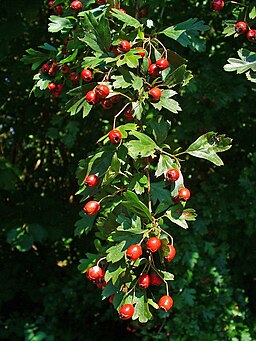
Crataegus monogyna 004

Another name for this tree was Fairy Thorn. Named by the ancient Bretons, they believed that the tree was haunted by fairies. English Hawthorn, Crataegus monogyna or C. oxycantha, was planted extensively as a hedgerow plant because of its quick growth and long thorns. The word “hedge” is in fact derived from the Anglo-Saxon word for hawthorn – Haegthorn.  According to one author, Frank Tozer, ancient hedgerows are becoming a thing of the past in England. He writes, “In densely populated Britain, Hawthorn hedges were very important to wildlife, as a source of both food and habitat. Indeed much of the wildlife in that country has disappeared in the past forty years, as hedgerows have been torn out to enlarge farm fields for mechanized farming. Another negative effect of their removal has been vastly increased soil erosion.” Hawthorns spread by suckers which can be a nuisance if planted in a small area, but does help to keep soil in place.
110 Crataegus oxyacantha L
There are several hawthorn species native to the United States. These are usually found growing along the edges of forests or meadows. Presidents George Washington and Thomas Jefferson planted Crataegus phaenopyrum on their estates.

In the Language of Flowers, Hawthorn symbolizes hope, marriage and fertility. A plant rich in English folklore, the ship which carried English pilgrims to the New World was named The Mayflower, after this plant. A pretty comprehensive survey can be found here.

Thank you so much Susan.

Challenge:
Susan gave us a tutorial in March about drawing.  So why not revisit the tutorial and this month use the Hawthorn.  You can download a colouring page I found on the internet.

Don't forget to use the linky to add your page.

Monday, 2 September 2013

The month of September

Our first month of the Autumn season.

September in the UK is associated with returning to school and the time when we celebrate the gathering in of the harvest.  There's some more information here.


There are some more really bizarre celebrations listed for this month.  How about Ask a Stupid Question Day or Fight Procrastination Day.  I probably need to celebrate that one!

Our Flower of the Month is the Hawthorn or May.  Interestingly September 16th is Mayflower Day remembering the ship that took the English to America.


  • The hawthorn was thought to be the ancestor of the maypole and was the source of May Day garlands. The rhyme “here we go gathering nuts in May” referred to the collection of knots (not in fact “nuts”) of may blossom
  • The saying, "Ne'er cast a clout till May is out" is thought to refer to the hawthorn blossom, not the month and was good advice that summer hadn’t really arrived until the blossom was in flower.   


  • Here's your September checklist.

    Art Challenge
    Make a page inspired by the information or poetry you have found here.

    Don't forget to share your work with us all via the linky.

    Sunday, 1 September 2013

    Introduction to the season

    In the northern hemisphere we are now moving into Autumn whilst the southern hemisphere is moving into Spring.

    In the UK, Europe & Commonwealth Countries we describe this season as Autumn whilst in America and Canada they use the word Fall.

    Find out more here.

    There's an interesting article here on the use of Harvest, Autumn & Fall.

    Autumn is a time of great change particularly in the colours of leaves before they fall from the tree.  New England is particularly famous for its Fall colours.

    And pumpkins.   Pumpkins are often seen outside houses in North America during October to celebrate harvest rather than Hallowe'en with which they are often associated.


    I love this song.

    Autumn poetry is often melancholic as the summer is over and we move towards winter.

    To Autumn     (click on the link for the remaining verses)
    Season of mists and mellow fruitfulness,
       Close bosom-friend of the maturing sun;
    Conspiring with him how to load and bless
       With fruit the vines that round the thatch-eves run;
    To bend with apples the moss’d cottage-trees,
       And fill all fruit with ripeness to the core;
          To swell the gourd, and plump the hazel shells
       With a sweet kernel; to set budding more,
    And still more, later flowers for the bees,
    Until they think warm days will never cease,
          For Summer has o’er-brimm’d their clammy cells.

    Other Autumn poems can be found here.

    Colour Scheme
    The colours we chose for this season are orange, mustard, brown and red.

    An Autumn theme
    The theme for the next 3 months is Gratitude and Remembrance.  You may want to do something to commemorate the anniversary of September 11th - there won't be anything particular on the blog about it.  If you're interested and you didn't join in last year you might consider making a gratitude journal.  At An Attitude of Gratitude you will find 30 days of prompts.

    Quotes and Bible Verses
    You can download pdfs from here:  Autumn Quotes     Bible Verses     Gratitude Quotes

    Challenge
    Make an Autumn related introductory page.

    Don't forget to add your page using the linky.